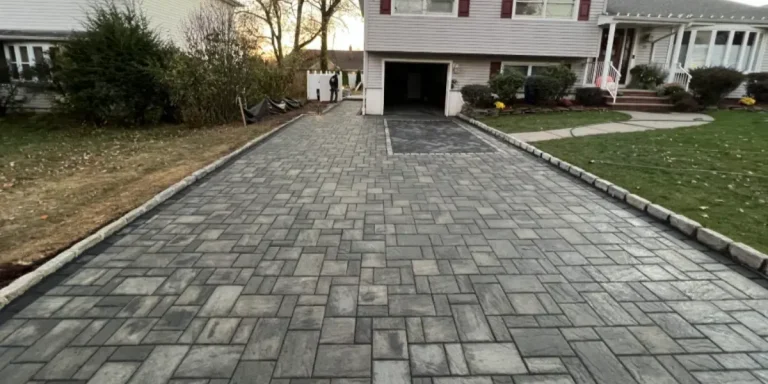
Rebuilding a Failing Retaining Wall
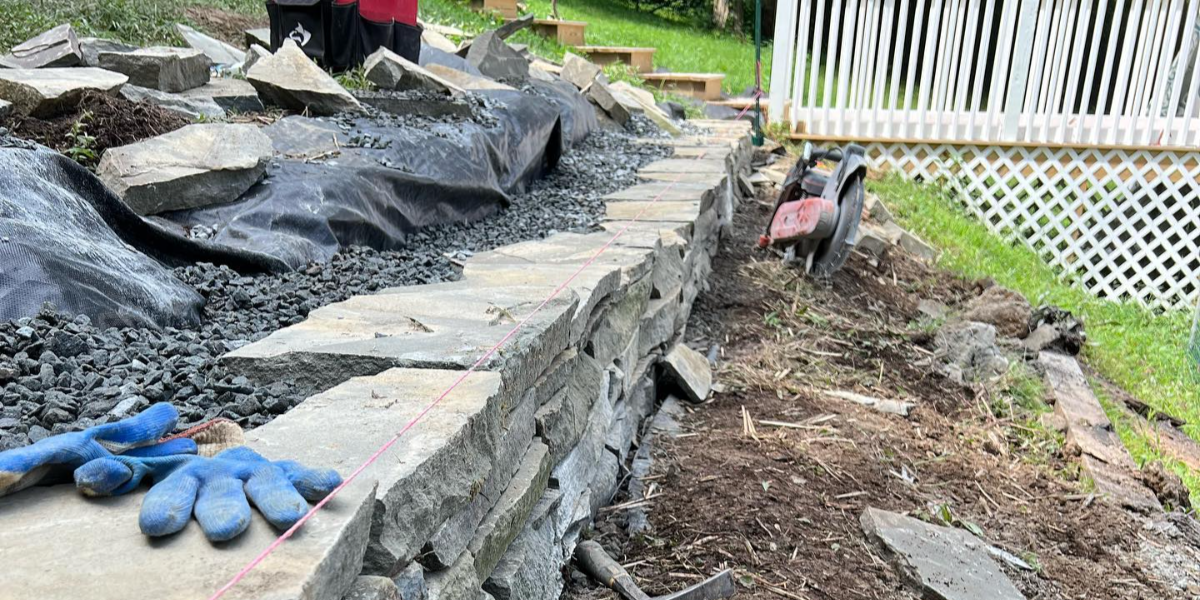
A leaning or cracking retaining wall is not always a candidate for a simple repair. In some cases, patching joints or replacing a few blocks only delays a larger structural failure.
At JBS Landscaping, we inspect and rebuild retaining walls throughout Morris, Sussex, and Warren Counties. Homeowners often ask whether a wall can be fixed or if it needs to be rebuilt entirely. In this guide, we’ll explain how to tell the difference and why rebuilding is sometimes the safer, more cost-effective long-term decision.
When minor repair makes sense
Not every retaining wall problem requires a full tear-out. Some issues are surface-level and can be addressed without reconstruction.
Situations where repair may be appropriate include:
-
- Loose capstones that can be reset and secured
- Isolated block movement caused by minor settling
- Small mortar cracks in older masonry walls
- Drainage clogs that can be cleared
In these cases, correcting the issue early prevents larger structural damage. Routine inspection and maintenance can extend the life of a properly built wall.
However, many failing walls show deeper problems that repairs cannot fix.
Warning signs that rebuilding is the better option
A wall that looks slightly off may be under significant stress behind the scenes. Cosmetic fixes rarely address underlying structural or drainage failures.
Common indicators that rebuilding is necessary:
-
- Visible leaning or bowing
Movement along the entire wall face signals structural failure. - Cracking through multiple courses
Widespread cracking suggests base or drainage problems. - Bulging in the center section
Often caused by hydrostatic pressure buildup. - Repeated shifting after previous repairs
Temporary fixes that do not hold indicate deeper issues.
- Visible leaning or bowing
If the base has rotated or the drainage system was never installed correctly, rebuilding is often the only reliable solution.
The hidden cause: drainage failure
Most retaining wall failures are tied to poor drainage. When water builds up behind a wall, hydrostatic pressure increases dramatically.
Over time:
-
- Saturated soil becomes heavier
- Pressure pushes against the wall face
- The base begins to shift outward
- Freeze-thaw cycles worsen movement
If the original installation lacked proper drainage stone, perforated pipe, or filter fabric, repairing the face of the wall will not solve the problem.
In these cases, we excavate and rebuild with proper drainage solutions integrated into the design.
Why rebuilding often saves money long term
Homeowners sometimes hesitate at the idea of rebuilding because it sounds more expensive than repair. But repeated patchwork repairs can add up quickly.
When rebuilding, we:
-
- Remove compromised material
- Excavate to a stable base
- Install properly compacted aggregate
- Add drainage stone and perforated pipe
- Reconstruct with engineered block or stone systems
The result is a wall designed to handle soil pressure and water movement correctly from the start.
A properly rebuilt wall can last decades. A repeatedly repaired wall may continue shifting year after year.
Mini case study: Full rebuild after repeated repairs
A homeowner in Chester contacted us after attempting to repair their retaining wall twice over a five-year period. The wall continued leaning after heavy rains.
Upon excavation, we discovered there was no drain pipe and minimal drainage stone behind the wall. Native clay soil had been used directly against the block.
We removed the failing structure, excavated to proper depth, installed compacted base material, drainage stone, filter fabric, and a perforated drain pipe system. The wall was rebuilt using segmental block with correct setback and reinforcement.
Since reconstruction, the wall has remained stable through multiple storm seasons.
Rebuilding also allows design improvements
A rebuild offers an opportunity to improve both function and appearance.
Homeowners often choose to:
-
- Increase usable yard space through terracing
- Upgrade to modern block or natural stone
- Integrate steps or seating walls
- Coordinate the wall with nearby hardscaping
In some cases, we combine retaining wall reconstruction with patio replacement or slope stabilization to address the entire landscape system.
For homeowners budgeting improvements, our Landscape Pricing Guide and Hardscape Pricing Guide outline realistic investment ranges.
Why DIY structural repairs are risky
Retaining walls are structural elements. Even walls under four feet hold significant soil pressure.
Common DIY mistakes include:
-
- Re-stacking blocks without addressing base failure
- Skipping drainage installation
- Using improper backfill material
- Failing to compact base layers correctly
Improper repairs can accelerate failure and increase future rebuilding costs.
Professional reconstruction ensures the wall meets structural standards and integrates drainage correctly.
Proudly serving Morris, Sussex, and Warren Counties
JBS Landscaping provides retaining wall inspection, repair, and full reconstruction services throughout:
-
- Columbia
- Allamuchy
- Budd Lake
- Chester
- Flanders
- Hackettstown
- Long Valley
- Newton
- Rockaway
- Sparta
- Succasunna
We also handle complete grading, drainage correction, and slope stabilization to ensure your landscape performs as a system.
Know when it is time to rebuild
Schedule your retaining wall evaluation today
If your retaining wall is leaning, cracking, or repeatedly shifting, a cosmetic repair may only postpone a larger issue. A professional inspection can determine whether repair is sufficient or if rebuilding is the smarter long-term solution.
Contact JBS Landscaping today to schedule a consultation. We will evaluate the structure, explain your options clearly, and recommend the most reliable path forward for your property.